Feeds:
Posts
Comments

Fava

Fava is a Greek dish made of yellow split peas which when slowly cooked for a period of time break down into a thick creamy mashed potato like consistency.  The velvety purée is then mixed with olive oil, lemon juice and seasoning.  Finally it is adorned with either raw or caramelised thinly sliced red onions and a scattering of capers.  Fava can be served warm or cold,  as a starter or to accompany meat or fish.  In winter it is particularly good with lamb Keftedes.

The crème de la crème of yellow split peas come from the island of Santorini in Greece.  Santorini is what remains of a volcanic crater.  The rich volcanic soil makes for a perfect growing medium for this unique strain of plant.  After over 3,500 years the Santorinians have learnt to perfect the fava pulse, giving us the famous fava with its unique flavour and texture.  Fava is eaten on Santorini as pasta is eaten in Italy.

Many years ago I spent part of my honeymoon on Santorini.   I remember being told two things about Santorini;  first it was like no other Greek island and secondly the prices where as high as the cliffs!  It didn’t disappoint on either point.  The views, exceptional light and the beauty of hundreds of pale blue and white houses perched high up on the cliffs as the ship comes into view of the island are stunning.

It is one of those places you should see just once in your life.   Standing on top of the island, some 300 metres from sea level the vista across to the other remaining islands is really breath taking.  The sunsets are legendary and the most romantic and stunning view is to see it setting from the village of Oia, which clings to the northern tip of the caldera.

Oia, we were told, was not to be missed on any account.  What was omitted from this advice (to me who doesn’t like heights) was the road to get there.  We caught a bus from Fira.  All was fine as I had no idea what was ahead so had sat next to the window.  As the town melted behind us and the road started to get more windy the bus in turn started to build up speed,  only slowing down slightly to swing around the bends.  I could no longer look out of the window as the ground had dropped away beside us and we were skimming along the top of the cliff.   All I could do was close my eyes and hope that the 30 minute journey would soon be over.  I could not wait to arrive in Oia until the thought occurred to me that we would have to return along the same road.   I shall skip over the drama that unfolded when it came time to return.  I can tell you that many buses left Oia without me –  each time it was time to get on I would find some excuse why that bus and that driver were not a safe bet.  Eventually I chose to risk my life with a driver whose impressive collection of religious icons and artifacts were displayed in the windscreen far surpassed the others.  No sooner had we pulled out of Oia did I realise that my intuition was not the wisest choice.  The driver obviously thought he had all angles covered and was untouchable.  The journey back was done in record time.   No doubt the driver went on to to do hundreds if not thousands more – for me as they say, it was the end of the road, never to be repeated.

This recipe can be made with any yellow split peas but Santorini fava is worth trying.  Alternatively, the quantities can also be easily reduced.  The olive oil, lemon juice and seasonings are added to your own taste.

Fava

Fava Santorini Φάβα Σαντορίνης

Ingredients

500 gms yellow split peas

water

salt

30 ml olive oil

2 red onions

1/2 lemon – juice of

Method

Wash yellow split peas well and put into a pot of water that covers them by an inch.  Add to this a peeled onion cut in half.  Bring to the boil, turn the heat down a little and skim off any white froth that rises to the top.

Reduce the heat, adding a little salt.   Place a lid on the pan and leave to gently simmer for about one hour.  Stir Regularly and check that the peas have not dried out.  If they have, add a little more boiling water.

After about an hour the split peas will have lost their shape and resemble porridge.

Remove from the heat and using a stick blender liquidise until smooth.  Put a tea towel over the pan and replace the lid.  Leave to rest.  As the fava cools it will thicken up more.

When ready to serve return to a very low heat for ten minutes and add the oil, lemon juice and any further seasoning.

Transfer onto a dish and add a drizzle of olive oil and either thinly sliced red onion or caramelised red onion and a scattering of capers.

IMG_3779

Quinces are hard not to miss; they resemble giant yellow pears and have the most wonderful delicate scent.  Inside their flesh is crisp almost hard which when cut discolours very quickly.  This and their tart taste can be forgiven as that same tricky flesh turns into the most beautiful pinky red colour when cooked.  This is a fruit so rarely seen in supermarkets and shops yet it has so much going for it.  Full of pectin, these fruits are fabulous in jellies and jams.  On top of which they are very versatile and can be used in sweet and savoury dishes.  Quince is often used with meat dishes.  Unlike other fruit it only takes three quinces to produce something truly delicious.

I was beginning to think that I would not see any qunices this year – if it weren’t for a tip off that some had been seen in the greengrocers in the next village.  Twenty minutes later I was on my way home with a large bag sitting on the passenger seat filled with quinces.  Oh how I long to have a friend who has a large quince tree in their garden with no use for the fruit.

I have a weakness for cheese and love the combination of a slice of cheese with something sweet such as a spoon of chilli crabapple jelly or a slice of the wonderful Dulce de Membrillo.   Anything that adds a sweet kick to the cheese is heaven for me.

Dulce de Membrillo comes from the Spanish for ‘sweet quince’.  The recipe has few ingredients; quinces, sugar and water.  Patience is needed for this simple recipe but it is well worth the effort.  The Membrillo will keep in the fridge for months.

Dulce de Membrillo

Ingredients

Quinces

Sugar

Water

Method

Wash the quinces well and place In a large pan (complete with skin) and fill with water to cover them.  Place a lid on the pan and gently bring up to the boil.  Then simmer for 40-45 minutes.  They are cooked when a knife is easily inserted into the centre.

Drain, discarding the water, and set aside to cool.  Once cool, peel the quinces and core them.  Liquidise the flesh until smooth.

Weigh the quince pulp and whatever the weight add an equal amount of sugar.

Place in a clean pan and return to a gentle heat.  Now the patience starts as the the sugar and pulp need to be stirred otherwise they will catch on the bottom of the pan and burn.  Keep doing this until the mixture becomes thick and you can see the bottom of the pan when you drag the spoon through it.

Beware of spitting because the mixture can become too hot and will spit.  Using a long handled wooden spoon helps to avoid this.

Transfer to a dish lined with greaseproof paper and allow to cool.

When cool remove from dish, wrap with fresh greaseproof paper and store in the fridge.

Note:  I made my Dulce de Membrillo with 3 quinces but I could have added less or more it doesn’t matter.  3 quinces produced for me two slabs measuring 12cm x 16cm.

Instead of putting the quinces in a pan of water they can also be baked in the oven.


Footnote

Quinces and quince trees seem to be hard to find and A Taste of Wintergreen posted a link on comments which sums up the problem in a really interesting article found here.

Another Quince fact is that they don’t stop at being a wonderful source of food they were also considered to be an aphrodisiac – probably the reason why seventeenth century London prostitutes were known as marmalade madams.   Ivan Day has written about the history of the quince in England with some wonderful pictures and recipes of quince – here

Rosehip Syrup

IMG_3777

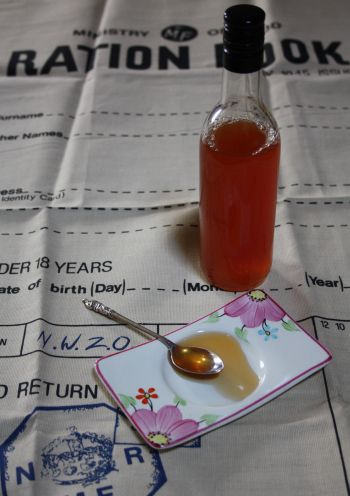
When I go out to walk the dog the bushes and trees are heavy with fruit and berries.  One of the prettiest sights is the abundance of rose hips this year.  The rich dark red shiny giant sized pips found on the dog rose bush stand out and look like ruby jewels. They are packed full of vitamin C along with an added helping of A, D and E not to mention the antioxidants.

photo(136)

Rosehip syrup became very popular during rationing in WWII.  The lack of oranges as a source of vitamin C was a problem for England but this was solved by the introduction of rosehip syrup.  A company called Delrosa based in Wallsend near Newcastle produced the syrup and so highly regarded was it that bottles would be given out at baby clinics and parents across the land would administer a spoonful daily in the fight against coughs and colds.  The taste is hard to describe but it is definitely sweet and has a tropical fruity taste with no nasty after taste.

A nationwide campaign began to encourage children to collect the rosehips in return for money and 3d was paid for every 1lb of rosehips.  3d was not a bad payment considering that at the time petrol cost 4d per litre.  So it was not just children who cashed in, many pensioners and low-income households also joined in.  To encourage the children even more, the incentive of the Rosehip Collectors club was started.  Each child was given a card to record their efforts and would qualify for a badge when they had collected a certain amount.  At the end of the season those that had collected four or more badges could then trade them in for a year badge.  There was even a special award the ‘Merit of Award’ badge that was made for those who collected the highest weight.

The rosehips would be delivered to their local collection points which were either schools, local post offices, or private houses.  This was organised by the Women’s Institute.

The above badges can be seen with others at www.badgecollectorscircle.co.uk who have kindly let me use their pictures.

My aunt remembered collecting and making the rosehip syrup whenever we walked past a bush and always referred to it being a filthy job, which she wouldn’t repeat.  Making rosehip syrup is a time consuming task but all the same a satisfying one.  Easy to pick but watch out for the thorns.  It is said that the best time to pick them is after the first frost.  My experience is if you wait that long you will find that the birds have beaten you to it and cleared the lot.

Rosehip Syrup

Ingredients

2 lbs rosehips

2 lbs sugar

4 pints water

Method

Wash the rosehips and then trim the tops and bottoms.   Cut them in half.

Put the 3 pints of water into a large pan and bring to the boil.  Once boiling drop all the rosehips in.

Bring back to the boil and then simmer for 20-30 minutes or until the fruit becomes soft and pulpy.  Set aside to cool.

Strain the liquid and pulp in a jelly bag or a double layer of muslin.

Try to resist the temptation to squeeze the bag as this will make the syrup cloudy.

Once all the liquid has dripped through the jelly bag remove the pulp and replace back into a saucepan adding the remaining 1 pt of water to cover the pulp.

Bring to the boil and set aside.  Repeat the process of straining through the jelly bag adding to the liquid already strained.  This process can be repeated a couple of times more but I prefer to just repeat it once.

Put all the liquid back into a clean saucepan and bring back to the boil adding the sugar, stirring until completely dissolved.   Remove from the heat.

If you feel that the liquid is a little on the weak side before adding the sugar you can boil down the liquid to reduce it.

The rosehip syrup is ready to bottle into sterilised bottles.

To sterilise the bottles

Wash the bottles in soapy water and drain.  Put onto a tray in an oven at Gas mark 3/325F/160C and leave for 10/15 minutes. Carefully take out and use.  The bottles should now sterilised.

cak

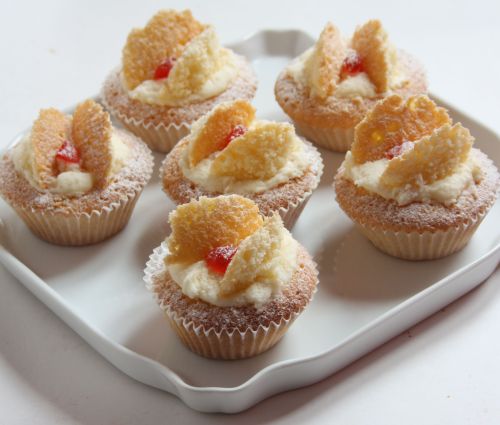
It wasn’t until Kathleen left a comment on one of my previous posts asking for the recipe of the fairy cakes I had mentioned, did I, after a lifetime, realise that what I have always referred to as fairy cakes are in fact butterfly cakes.  Looking at them I can’t believe I ever thought they could be called anything else.  The cake tops are sliced off and cut in half to resemble the wings.

These little cakes are so easy to make and have a smaller margin for failure than a full size, Victoria sponge.   Even though they are made with the same recipe and formula.  Add to this that the vanilla frosting does not have to be piped as in cupcakes,  just applied neatly with a knife, make these perfect for baking with children.  Even if the wings are not precise or the frosting uneven a sprinkling of icing sugar forgives all.  I limited the decoration to a small piece of cherry but there is no end to what you could sprinkle and decorate them with;  chocolate buttons, hundred and thousands or even left plain.

When I made this batch I thought I would tart them up and pipe the frosting.  While I rummaged in my baking drawer to look for the icing nozzles I gave it some thought.   That wasn’t how they used to be made.  They were always slightly rustic with no two being the same, which is what gives them their charm.  As the saying goes ‘if it ain’t broke don’t fit it’ so I have not meddled and made them as I have always known them.  Perhaps, with the only difference being that I have finally got their name right.

I have given a generous recipe for the vanilla frosting.  I either use all of it on the 12 cakes or I am less generous and split it over two batches.  The frosting will keep in the fridge for a day or two if covered tightly with cling film but will harden so needs to be left out while the cakes are cooking to soften up.

There are two problems with these.  Firstly,  just one is never enough and secondly how to hide the pile of empty paper cases sitting in front of you.

Butterfly Cakes

makes 12

Ingredients

4 oz/110g butter softened

4 oz/110g caster sugar

2 eggs

4 oz/110g self raising flour

3/4 glace cherries for decoration cut into quarters

12 Paper cases

Turn oven to 190C/350F/Gas 4

In a bowl beat softened butter and caster sugar until pale.  Add one egg and beat.  If the mixture begins to curdle add a tablespoon from the measured self raising flour and beat until smooth.  Add second egg and mix well.  Fold in flour.  Divide up equally into the 12 paper cases.

For extra support I place my paper cases in a bun tin.

Place in the oven for 20/25 minutes.

They are cooked when a skewer is inserted in the center comes out clean.  They should be a light golden colour.

Leave to cool on a wire rack.

When cool, cut out a disk from each cake with a knife.  This is then cut in half to create the wings.  Place a small amount of vanilla frosting to cover the hole and then gently push the two halves into the icing.  Finish with a small piece of cherry.

Sprinkle with icing sugar.

Keep in an airtight container.

Vanilla frosting

Ingredients

4 oz/110g butter softened

8 oz/225g icing sugar

3 tbs milk

1/2 to 1 tsp vanilla extract

In a bowl mix together the butter and icing sugar until smooth and well combined.  Add the milk and vanilla extract and mix well.

Apply to cakes.

and how the simplest of recipes can go wrong.

Asparagus season is upon us.  The weather is glorious, blue skies, sun and a slight wind.  Just as I like it.   So today is the day for the pilgrimage to Brantham in Suffolk for asparagus.  We had discovered this little shed by accident after our usual habit of trying to find a short cut.  An unexpected rustic sign for fresh asparagus and a dirt track beckoned to us.  We felt brave and turned in.   I have ventured down many little tracks in the hope that I would find an array of wonderful produce only to be disappointed with a mediocre selection of tired and passed-it specimens, followed by the sinking guilty feeling that to be able to get back in and drive away I am going to have to buy something with the guarantee that I never have to return.

Well, this rustic sign did lead us to a wonderful treasure of not only asparagus but rhubarb and eggs to name but a few.  This rustic sign is firmly on the list to visit annually.   A pilgrimage would sound as if it were a one off –  but we will be going often until the asparagus season is over.

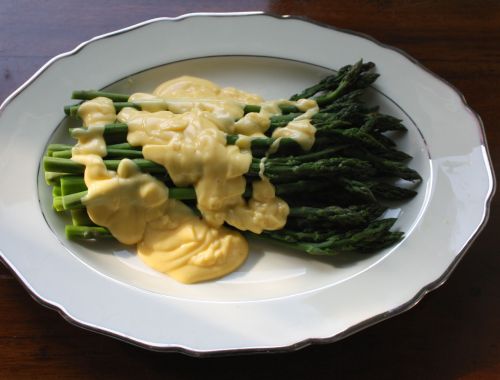
Lunch was now sorted – fresh asparagus and hollandaise sauce – life couldn’t be better.  Except that by the time I got home via a couple of nurseries time had marched by and I was now having to rush.  As I started to get things out to prepare the asparagus I happened on a brainwave of microwaving the hollandaise.  What a short cut, what a triumph it will be.  Disaster is what it was!

I shall say that the moment I put the butter in the microwave to melt did my problems begin.  I was too busy fussing over the gentle cooking of the asparagus to remember the butter until the sound of a minor explosion from the microwave started the unraveling of my calm.  I decided to ignore the issue of the butter coated microwave and  continued to pour the remainder of the hot butter onto the eggs and vinegar giving it a quick beat and then without a glance shuffling it back into the microwave for a few short blasts, it wasn’t until a couple of blasts that I noticed the sauce begin to split and curdle. With each blast the splitting and curdling got worse.   The asparagus by now was at its perfect cooked state.  So in a fit of panic I decided to resuscitate  the sauce by blitzing it with the Bamix – the stuff went everywhere – hot curdled butter can travel and not in a good way.

Abandonment was the only option.  The asparagus that I served for lunch with melted seasoned butter was very nice.

After lunch I convinced myself dramatically that my relationship with hollandaise was over and I would never  make it again.

By early evening I was over it – I love hollandaise too much to turn my back on it.  Made by the Marco Pierre White’s method works for me.

as MD - Copy

Asparagus

Wash and trim the bottoms of the asparagus.  If I have bought them straight from the farm I just want to get them cooked and on the plate as quickly as possible.  So I either steam them or if I haven’t got my asparagus pan to hand I use a frying pan, that way I can leave the tips outside the water and at the last minute push them in.  I find this a quick method but one that needs constant watching as the asparagus only take a few minutes to cook.  To judge when they are done push the point of a sharp knife into the flesh.

Hollandaise Sauce

Ingredients

25ml vinegar/lemon juice (either or both)

2 large egg yolks

200ml melted butter

Salt and pepper

Method

Place the egg yolks in a bowl that will fit over a saucepan, you don’t want the bottom of the bowl touching the water.

Add the vinegar and beat.

Add the melted butter and beat.

Now place the bowl over the saucepan and keep lightly beating.   After a few minutes the sauce will begin to thicken.

Serve.

Hollandaise needs to be eaten and not stored.

Madeleines

madel SL-1

When I was a child it seemed that every mother was baking for all she was worth, turning out all sorts of fancies and iced novelties.  A lot of them are just distant memories now, but I can remember my mother getting very frustrated  in the kitchen when she couldn’t find a recipe she had been given for some fancy cake or other.  Always asking me if I had seen it?  As if!  My interests were limited to what Cindy was wearing, not worrying where my mother kept her recipe collection.  My involvement was in the finished product not how it got there.

Now I am all grown up, I too get frustrated in trying to recreate those same recipes, either by trial and error or by asking around.  Someone usually has a recipe handed down or can still remember how their mother made them. The same can be said for my Great Aunt Beatie’s recipe for clotted cream.  I wish now that I had taken notes.

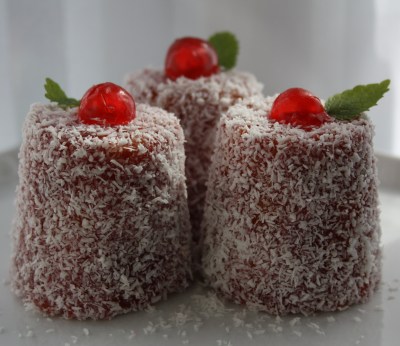
It was in a telephone conversation recently that we discussed how fantastic everything was when we were children, days of ever lasting sunshine and school holidays that stretched on for ever, that the memory of Madeleines came up.  I don’t think I have seen them around for many decades so perhaps they are ready for a comeback!   The English Madeleines are very different to the French ones which are baked in shallow shell shaped moulds.  These are baked in dariole moulds covered in jam and then rolled in coconut.  The only major tip I would pass on, if you decide to make these, is to make sure you grease, grease again with butter and then flour the moulds, because the sponge has a tendency to stick.

Madeleines

Ingredients

100g/ 4 oz butter

100g/ 4 oz caster sugar

2 eggs (beaten)

100g/ 4 oz self raising flour

60 ml (4tbs) strawberry jam (or any red jam that is mainly jelly not whole fruits)

75g/ 3 oz desiccated coconut

glace cherries halved to decorate and a few mint leaves.

8 Dariole moulds

Method

Turn oven to Gas mark 4 (180C/350F).

Grease and flour 8 dariole moulds – this is one of the most vital parts of the recipe, if the moulds are not greased enough the cakes will not come out in one.  Put these onto a baking tray.

Beat together the butter and sugar until the mixture is pale and fluffy.  Add the eggs a little at a time.  Then using a metal spoon gently fold in the flour.

Fill each of the dariole moulds 2/3 full with the butter mixture.

Bake in the oven for 20-25 minutes (depending on your cooker) the cakes should be risen and when gently touched should spring back.

Cool slightly in their moulds.  You want them to have cooled enough to handle. If you remove them from the moulds straight from the oven they will break.

To turn these out I run a knife around the edge to loosen them and then gentle shake – they should come out in one.  Leave them to cool on a wire rack.

When the cakes are cool slice any excess from the bottom so that they can stand flat – I put mine back into the moulds and used the bottom edge as a guide.

Melt the jam in a pan and pour onto a plate.  On another plate spread the coconut out.  Either brush the cakes with the jam or roll the cakes gently in it, be generous making sure that the surface is covered otherwise the coconut won’t stick.  Then roll in the coconut.  The idea is to cover the tops and sides leaving the base clean.

Top with the glace cherry and serve.  To store keep in an airtight container.

Tsoureki

IMG_3579

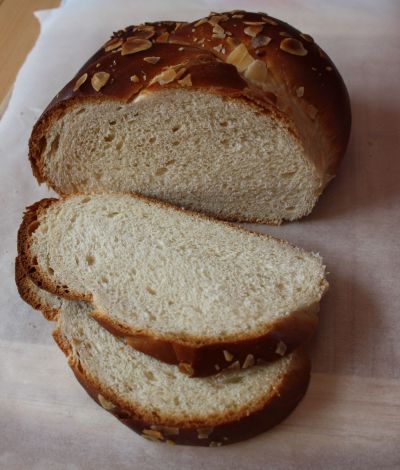
Tsoureki is a Greek bread traditionally baked at Easter.  It has a smilar texture to brioche but not as buttery.  It is either braided as a loaf or braided in a wreath.  Both are brushed with egg wash and decorated with sesame seeds or flaked almonds and studded with red dyed eggs.

I have to date no family recipe to share as my mother never made Tsoureki.  We always had a Tsoureki sent over from Greece for Easter.  Having a dislike of the red eggs I would always steer clear of it.  As with everything, my tastes have changed.  Once a year I like to bake my own Tsoureki (without the red eggs embedded) and it has become a bit of a pilgrimage for me in finding the perfect Tsoureki recipe.  Each year I try a new recipe.  This year I have used the recipe from Stellios Parliaros a very well known Greek patissier.

The recipe comes close to what I am looking for but it didn’t quite have the sweetness.  Also I felt that instead of the single Tsoureki I would probably make two instead as it was rather on the large size.

A word of advise on the mastic.  When grinding it has a tendency to melt and cling and is quite difficult to get off.  Hence I am guessing why the recipe says not to allow the mastic with milk to get too hot.

Both the mahlepi and mastic were hard to find but they give the unique taste to the tsoureki and should not be left out.  They also give an aroma which immediately transports me back to Greece. These two spices really are for me what makes a Tsoureki Greek.

Mahlepi is an aromatic spice which comes from the kernel of seeds of the wild cherry.  The smell is unusual and has a sour note.  The Mastic  is the sap from the Lentisk tree which grows on the island of Chios.  It becomes brittle by the heat of the sun.  Mastic was apparently the original chewing gum hence its ability to stick to my pestle.  Both spices are used in middle eastern and Mediterranean cooking.

IMG_3519

Tsoureki

Ingredients

70g Butter

100ml milk

160g caster sugar

3 eggs

5g ground mahlepi

5g ground mastic

100ml lukewarm water

40g fresh yeast

650g strong flour

1 egg for brushing

Flaked almonds or sesame seeds to decorate

Method

In a saucepan gently heat the milk, butter, sugar mahlepi and mastic making sure the temperature does not rise above 50C

Remove from heat once all the ingredients have melted.  Strain the liquid through a sieve to remove any pieces of mahlepi or mastic set aside.

Dissolve the yeast in the lukewarm water and add to the butter, milk, sugar, mahlepi and mastic mixture.

Add the eggs and mix well.

Put the flour into a large bowl and make a well, add the liquid ingredients and knead.

Ideally use a mixer with a dough hook.  The dough is very sticky at first and the secret here is not to add more flour but to continue to knead.  The more you knead the less sticky the dough becomes.   The dough is ready when it stops sticking to your hands.  I also found when handling the dough it helped to flour my hands.

Remove the dough and form it into a ball and place in a clean bowl with some flour sprinkled on the bottom.  Cover with a tea towel and leave to rise.  It will take about 3 hours to triple in size.

When risen, remove the dough and knead again for a few minutes on a lightly floured board.

Divide into three equal balls.  Roll the balls into three long strands of equal length.

Line the long strands in front of you and pinch them tightly together at one end.  Plait the strands and then finish off pinching them firmly off,  tucking the ends under themselves for neatness.

At this point if red eggs are to be placed in the bread this is the time to do it.  If you attempt to do this after the second rising you will lose the air in the dough.

Place on a baking sheet and leave to rise about one hour until double in size.

Brush with egg very gently avoiding getting any egg wash into the creases.  Sprinkle with flaked almonds/sesame seeds and bake for about 45 minutes to an hour 180C/Gas 4

The Tsoureki is ready when it is golden brown.  I also like to insert a skewer into the middle to check that it comes out clean.

It will keep well for a week in an airtight container.  After a couple of days I tend to slice mine and toast it.

IMG_3557

Today is Holy Thursday in the Greek Orthodox Church and it is traditional to make red eggs along with tsoureki:  a sweet brioche type plaited bread which is commonly decorated with red eggs.

The red colour is to symbolise life and the blood of Christ.  The red is achieved by either boiling the eggs with white onion skins or buying a dye kit which is applied to the eggs after they are boiled.  The eggs are then polished with a little bit of olive oil on a cloth or with shellac supplied with the dye kit.  I favour the dye kit method for colouring the eggs as then I don’t have the problem of using up fifteen large onions, but skip the shellac process preferring the more natural olive oil method to give a sheen to the eggs.  A very small dab of olive oil on a piece of kitchen paper goes a long way.

I love the tradition of the red eggs and enjoy making them each year but  I don’t eat them and have never encouraged the family to do so either.  I am sure the red dye is not good for you hence the reason why I never put red eggs in my tsoureki.  I know my thinking is not always popular!

Once the eggs have been dyed they are placed before the Icon until Easter Sunday when the eggs are passed around and the aged old game of tsougrisma/τσούγκρισμα is played.  The idea being that each person takes a red egg and gently taps someone else’s egg.   The aim being to crack their opponent’s egg.   Usually just before the tapping the words Christos Anesti (Christ is risen) with the reply Alithos Anesti (truly he is risen) are exchanged.  The last egg to remain in tact is the winner with its owner having good luck for the year.

When we were not in Athens for Easter we would go to Saint Sophia’s in Moscow Road, London.  Usually for both Good Friday and then on the Saturday for the midnight service.  The Saturday service is very moving and the church is usually packed with little room to move let alone hold a candle.  Everyone is waiting for the Resurrection and just before midnight the church is plunged into darkness and silence.  At exactly midnight the priest will light his candle announcing ‘Christos Anesti’.  From his candle the flame is passed around the church, and the choir starts to sing and the Easter celebrations begin.  Before leaving the church which was always a mad panic we would collect our red eggs and holy bread offered on trays and baskets around the church.  The bread was then promptly wrapped up by my mother and put into her handbag never to be seen again.

The first year I joined my mother in observing Lent I didn’t quite realise how hard it would be and how hungry I would become.  All I could think of on the Saturday midnight service was what I would eat when I got home.  I think that the mad dash afterwards might have meant that others had the same idea.  When I was given my red egg and holy bread  I made sure to hang onto them myself and not pass them to my mother to look after.  I had been told to wait until I got home before I ate anything.  As my mother was busy waving to everyone and shouting greetings to all,  I slipped into the back seat of the car.   I quickly started to peel my egg,  eating it whilst taking nibbles from the holy bread stored in my coat pocket before my mother could turn round and stop me.    The taste was not that good but it was well received by my stomach.

Red Eggs

Using a red dye kit

Boil as many eggs as required for eight minutes.

Cool

Mix the dye powder with cold water and dip the eggs in.  The instructions say 3 minutes ONLY but I dipped mine in a second time to achieve a slightly darker colour.

To make the shape of the Cross I cut out the shapes from white address labels and struck them on, after dipping the eggs in the dye and waiting for them to dry I peeled off the label.  I did find that a good rub removed any stubborn traces of glue.

Then with a piece of kitchen paper and a tiny bit of olive oil I polished all the eggs.

CamembertMD

Camembert enrobed with puff pastry eaten warm from the oven is delicious, and worse still there is a compulsion to cut another slice until there is no more left.  Eaten plain or with chilli crab apple jelly it makes a good starter or a replacement to a cheese board.

The riper the Camembert the runnier the finished pie.  Try to avoid using a very soft Camembert because when you open the oven door you will find most of it has run out of the pie and flowed all over the baking tray.  I used a young  firm Camembert as I wanted to photograph it.  Photography is not my strong point, and photographing my recipes seem to take longer than actually making them.  I have little idea of what I am doing but have come to the conclusion that if I take enough pictures in an array of positions then there will have to be at least one reasonable picture.

Hence my choosing a firm cheese that would cope with sitting around.  The Camembert didn’t last long and even though it was slightly firmer than I would have liked it was just as delicious and was given a sweet note by the crab apple and chilli jelly.

This simple little recipe was the one that finally won me my father’s praise.  My father adored his food especially cheese.  He would come and stay with us for a week at a time.  Always keen to help with any outstanding projects.  The idea was that he would work away while I stayed in the kitchen cooking up a full English breakfast, mid morning snacks, a full scale lunch, afternoon tea with cake and then supper.  We loved his visits, but the kitchen was under a lot of pressure to produce and impress.

On one of my father’s visits I had been busy baking batches of fairy cakes for the expected afternoon tea slot.  I had left them to cool on wire racks on the kitchen table while I answered the phone, when I returned they had disappeared into thin air.  The wire racks were still there but no cakes.  I rushed out into the garden and asked my father if he had eaten them (it had been known).  No, so where had they gone?  I looked in all the cupboards, where could I have put them?  I couldn’t work out in my mind where I might have put them.  It wasn’t until out of the corner of my eye I saw a tiny piece of cake paper on the floor did I realise who the culprit was – Oscar our Labrador.  He had decided to wolf the lot, maybe in the faint hope that without any evidence he wouldn’t get the blame.  He was sent to his bed and my father’s response was that the dog couldn’t be blamed; I shouldn’t have left them there!

My father ate everything with gusto and enjoyed what he ate but to get a rapturous response was a little more difficult.  It was serving up the baked Camembert that really impressed him, he wolfed it down and was even raving about it on his way up to bed.  I couldn’t believe my luck.  That something so simple would be my crowning glory!    He even made a point of  mentioning it a couple of days later when I waved him off on the train platform.   I think he wanted to make sure it was on the menu for his return visit.  Little did he know it would be on every future menu!

The puff pastry can be shop bought or home made, but as always nothing really compares to home made.

BakedCamembert

Baked Camembert

Ingredients

A round of Camembert (slightly soft)

a little beaten egg

250g/9oz puff pastry

Method

Oven Gas mark 7/220C/425F

Roll out two circles of puff pastry to the thickness of a 20p piece.  Making one of the circles larger by two inches.  Don’t be tempted to keep the pastry thick as it will cook on the outside but leave a soggy uncooked mess on the inside.

Place the Camembert on top of the small circle of pastry and brush the edge with beaten egg.

Place the larger circle of pastry over the top of the Camembert and seal around the base using a fork.  Trim to neaten.

Brush the whole pie with beaten egg and add decorations with any left over pastry if wanted, brush again with the egg and place on a baking tray.

Place in the oven for 20/25 minutes.

Ready when the pastry is golden brown.

Serve immediately on its own or with crab apple chilli jelly.

It is just as delicious cold but really needs to be eaten the same day.

CrabapplechillijellyMD

I am a little early in posting this recipe, as we are a long way away from crab apple season in England.  There is a reason. All will become clear in the next post.

A crab apple is a small apple that looks not unlike a large rosehip.  From the colour you might think they would be sweet, in fact they have a sour and tart taste and, are not known for their eating quality.  They are though, a wonderful producer of jellies mainly because of their high pectin content.  They also make delicious wine – but that’s another post.   If you don’t have enough for a jelly they can be roasted and served with meat.

crab apples

The crab apple has been around for many years, mentioned by William Shakespeare and attached to legend.  Throw their pips into the fire whilst saying the name of your true love and if the pips explode then your love is true.  Best done without your husband present – just in case!  The sport of gurning (extreme pulling of face) originates from when the Lord of the Manor gave crab apples to the poor of the village.  The faces they pulled when biting into the sharp little apple then turned into a competition on who could pull the ugliest of faces.  This tradition is still kept alive today at the Egremont Crab Fair which began in 1267 in Cumbria, England.

For me, one of the nicest preserves to make is Chilli Crab Apple Jelly, mainly because of the beautiful clear golden elixir and delicate flavour that the crab apples produce.  The chillis adding a kick which brightens up the recipe.

A worthwhile quantity to use is 4lbs of crab apples, which is what I have used in the recipe below.  There is no reason why you can’t make less or more as again there is a mathematical formula to this recipe.  After simmering the apples and straining them it’s the amount of liquid produced that dictates the amount of sugar used.

This recipe is for chilli crab apple jelly but there is no reason why you can’t substitute that for other spices.  The heat of the jelly is again down to your personal taste.  The quantities I have given here are for a light kick of chilli.  I think the secret is to allow the delicate taste of the crab apple to come through without killing it off with too much chilli.

Chilli Crab Apple Jelly

Ingredients

4 lbs Crab apples

Sugar – granulated or caster

3 Chillies – seeds left in and chopped.

(How much heat you want is controlled by how many chillies you put in and the type of chilli).

Water

Method

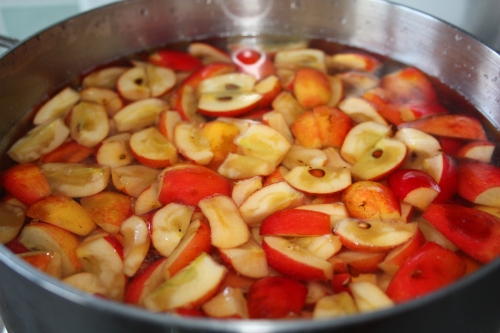
Wash the crab apples and top and tail.  Cut each apple into four (no need to core) and put in a large pan along with the chopped chillies.

Crab apple and chilli pan

Add enough water to just cover the apples and cook gently for about 45mins/1 hour with the lid on. They are ready when the apples are at the mushy stage.  Strain, using a jelly bag or a piece of muslin placed over a sieve. Leave for a couple of hours or more so that all the liquid gets a chance to drip through.

Before placing the strained liquid into a clean pan measure the amount.  You will need 1 lb of sugar for each pint of liquid.

If there is a fair amount of apple mash left in the jelly bag, returned it to the preserving pan, adding a little water and reheated it for a further half hour.  Strain this again using either a jelly bag or muslin.  Then again measure the quantity of liquid adding the required addition of sugar to the main batch.

Gently heat the liquid with the sugar making sure to keep stirring the sugar until it dissolves in the pan.  When the sugar has dissolved, turn the heat up, to bring the jelly to a boil.

When the jelly has started to boil it will produce a scum on the surface, remove any that appears – there will be plenty!  Keep skimming, as the less scum there is the clearer the jelly.

At this point use a jam thermometer; you need the liquid to reach ‘ jam’ temperature. The thermometer is not essential but is very useful. Alternatively, when you think the jelly is reaching setting point take a small saucer and pop it in the freezer to cool.  Remove from the freezer and put a little of the jelly onto the plate and leave to cool (you can put it in the fridge for a couple of minutes) and then push your finger against the jam.  If there is a skin which forms a wrinkle when pushed then the jam is ready.

Set aside for ten minutes for the jelly to cool slightly and then pour into warm sterilised jars and seal.

Do not use a wax disc and a screw top lid.  The wax disc stops the twist top from forming a seal.  If using a wax seal then cover with cellophane and secure with a rubber band.

To sterilise the jars wash them in hot soapy water and rinse.  Place on a baking tray and put into a warm oven Gas mark 3/325F/160C and leave for 10/15 minutes.  Carefully take out and use.

Remember to label and date.  I have learned this to my cost.  You think you will remember but trust me you won’t.