Feeds:
Posts
Comments

Anzac Biscuits

Not a biscuit I had really heard of until a month ago.  I was talking to my cousin about our usual obsession of what each other is cooking and eating when she mentioned that she was baking some Anzac biscuits, how fabulous they were and that she used to cook them all the time.  Since then they have cropped up in conversation so many times that my intentional disinterest turned into an interest.  I googled Anzac Biscuits and was surprised to see how popular they were.  Which rock had I been sitting under?

The name comes from the Australian and New Zealand Army corps.  In World War I the families of the soldiers would often send these biscuits out to them as they kept so well during transportation.  The Australians are so protective of the name that there are laws protecting the recipe.  Apparently, Subway had to stop selling them because making the biscuits to the original recipe was too expensive to be cost effective and they were not allowed to sell anything else under that name.

The recipe for Anzac biscuits seems to be the same wherever I looked, with one exception, which is where someone has added raisins.  The classic recipe is the one I decided to try (little choice really).

Anzac Biscuits

85g/3 oz  porridge oats

85g/3 oz  desiccated coconut

100g/3 1/2 oz plain flour

100g/3 1/2 oz caster sugar

100g/3 1/2 oz butter

1 tbsp golden syrup

1 tsp bicarbonate of soda

2 tbsp boiling water

Heat oven to Gas mark 4/180C/fan 160C.

Put the oats, coconut, flour and sugar in a bowl.

Melt the butter in a pan and then stir in the golden syrup, I put a tablespoon in a mug of hot water for a few minutes to heat, this stops the syrup from sticking to the spoon and stops all those strings of syrup getting everywhere.

Add the bicarbonate of soda to 2 tbsp boiling water, stir then add to the golden syrup and butter.

Make a well in the middle of the dry ingredients and pour in the butter and golden syrup mixture. Stir gently until all the ingredients are combined.

Put dessertspoonfuls of the mixture on to greased baking sheets, about 2.5cm/1in apart to allow room for spreading. Bake in batches for 8-10 mins until golden. Transfer to a wire rack to cool.  I left my last batch in for a few extra minutes to see what the change would be.  They were darker and crisper.  I preferred the earlier batches which were crisp with a slightly soft centre.

Beware – eating just one is impossible.

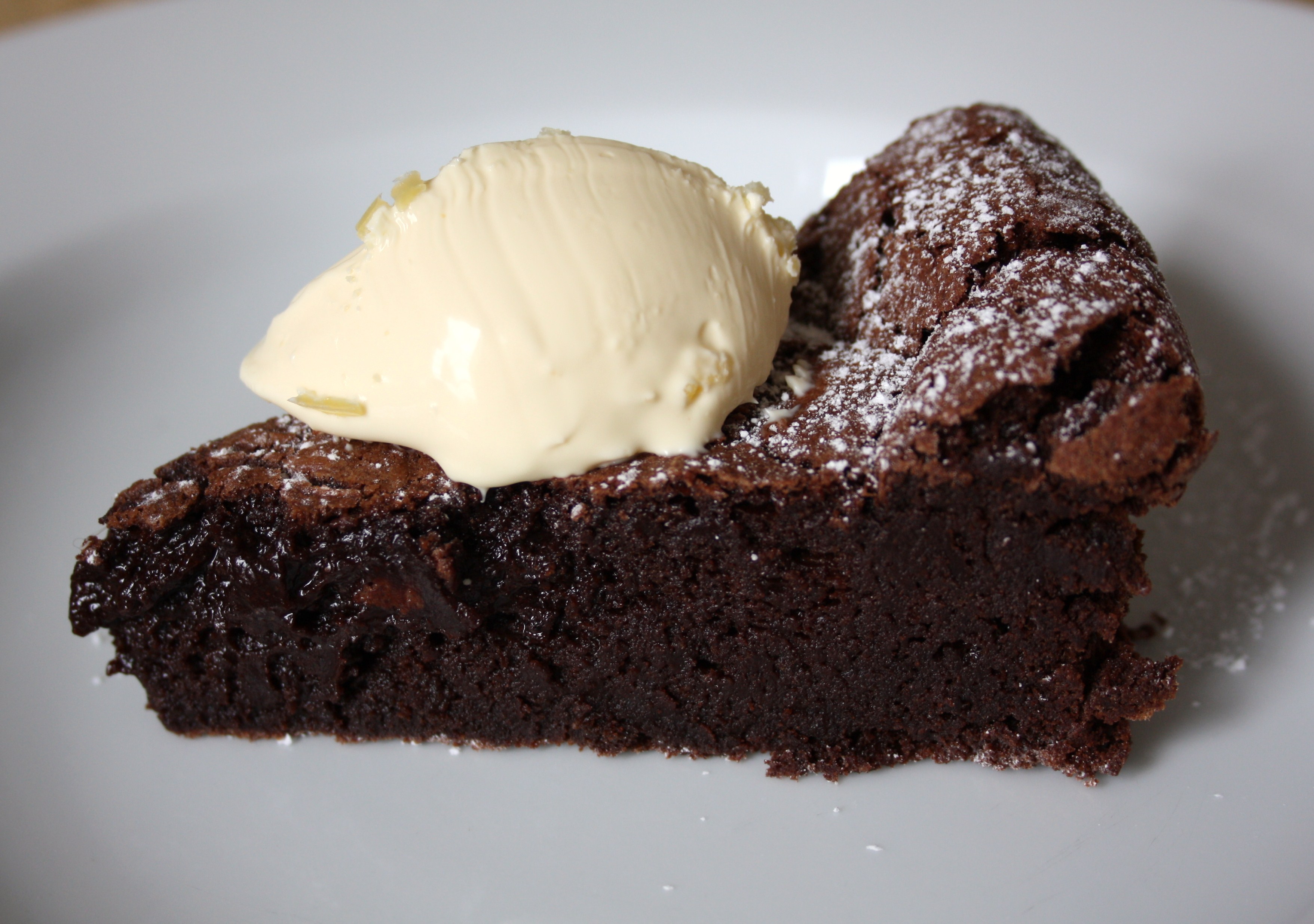
Sometimes a simple sponge cake is just not enough.  Not grown up enough.  A good old Victoria sponge doesn’t quite go with an espresso but this is a cake that does.  Its rich, moist, decadent and indulgent, and if that’s not enough it’s flourless.

Everytime I make this cake I just can’t quite believe that it will work.  A cake without flour seems odd.  It never to let me down.  Once it goes into the oven that’s about it, there is no filling, nothing more to add save a dusting of icing sugar and its ready to serve.

When I first started making a version of this recipe years ago I kept thinking I was not getting the recipe right or rather there was a flaw in the recipe because each time I removed the cake from the oven the top was cracked and the middle gooey.  I came to realise that either it was a happy mistake or it was meant to be like that.

This has to be my favourite of chocolate cake recipes.  It is pure chocolate cake heaven.    Can be served on its own with a dusting of icing sugar over the top, or as we like it, with a large spoon of clotted cream.

Flourless Chocolate Cake

Ingredients

200gms Dark Chocolate

100gms/3 ½ oz butter cut into small cubes

4 large eggs

185gms/ 6 ½ oz icing sugar

19 cm non stick cake tin

Method

Put the oven on to Gas Mark 4/180C/350F.

Break the chocolate into a bowl.  Add to this the butter.  Place the bowl over a saucepan of hot water without the bottom of the bowl touching the water.  Leave this on a low heat, making sure the chocolate melts gently.  As soon as the chocolate and butter have completely melted remove from the heat.

Separate the eggs.  Set aside the whites.

Whisk the egg yolks and all the icing sugar until pale and creamy.

Fold the melted chocolate and butter into the egg and icing sugar mixture.

Now whisk the egg whites until soft peaks form and then gently fold them into the chocolate mixture, making sure you have completely combined the whites with the chocolate mixture.

Carefully pour mixture into cake tin and place in the oven for 30 minutes.  All ovens are different, I tend to allow an extra 5 minutes if using my old gas cooker.

When cooked the cake will have a cracked top and be still gooey in the middle.  Dust with icing sugar and serve.

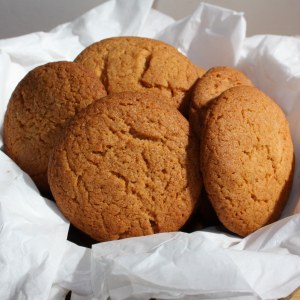
I am not a big fan of stem ginger, never have been but ginger in other forms is something I do like the taste of, especially in biscuits and cakes.  Gingernut biscuits have a warm slightly spicy taste to them.  They are just the perfect constituency for my habit of dunking in a cup of tea.   Unlike other biscuits that are easily broken or crumble, these are a little more robust.

I had forgotten how easy they are to make and how good they taste.  The only thing I will say is that they do need watching whilst in the oven.  Just before the baking time is up, check them and if needed, turn the baking tray round to stop the edges from burning.

Gingernut Biscuits

Ingredients

4 oz/100g self-raising flour

½ level tsp/ 2.5 ml bicarbonate of soda

1-2 level tsp/ 5-10ml ground ginger

1 level tsp/ 5 ml ground cinnamon

2 level tsp/ 10ml caster sugar

2oz/ 50g butter

3 oz/ 75g golden syrup.

Boil a kettle of water and fill a mug with the hot water and place a metal spoon in it.  After a couple of minutes take the spoon out and use to weigh out the syrup.  The heat prevents the syrup from sticking thus making life a lot easier

Method

In a bowl put the flour, bicarbonate of soda, ginger, cinnamon and sugar.

In a pan heat the butter and the syrup together until the butter melts.   Start the butter off on medium heat – you need to watch the butter, as you don’t want it to burn (burnt butter can nearly always be detected in the finished product).  Once melted pour into the dry ingredients and mix well, using a wooden spoon.

Lightly flour your hands and take an overloaded teaspoon of gingernut dough, roll into small balls, place well apart on greased baking sheets and flatten slightly with the back of a spoon.

Bake in the oven at gas mark 5/190C/375F for about 15 minutes.  Cool for a few minutes before lifting off baking sheet and place on wire rack to cool.  The cracked top that appears, is normal, this is supposed to happen.  Keep in an airtight container.

Kourabiethes

Kourabiethes are a Greek biscuit, made at Christmas, Easter and Weddings.  The texture is very much like shortbread with the addition of brandy and almonds. These biscuits have been made for generations and there are so many variations of the recipe.

I use my great grandmother’s recipe.  I like the thought that a hundred years on I am re-creating her recipes, which no doubt she took from her mother, and so it continues.  I don’t think when she was writing the recipes down, she would ever imagine that her book would be read and treasured and her recipes cooked in an English kitchen.  What she wouldn’t know is how much I struggled with translating her writing and in places her lack of instruction!  I am guilty myself of writing the recipe down in a shorthand style.

In the picture the Kourabiethes sit on her plates and so without too much imagination I can guess that those plates have seen kourabiethes many times in the past.  What we eat is so important to keep us alive and healthy but it has many facets, the saying food for the soul is a very true phrase.  These biscuits are for me food for my soul and a thin golden thread that links me into a past and a tradition.

The biscuits are normally made in a small domed bun shape or a crescent shape.  I have read somewhere that is this is because during the Turkish occupation of Greece, the Turks insisted that the biscuits be cut in a crescent to represent their flag.  I just don’t know if this is true .

I have made some changes to the original recipe.  Firstly I didn’t soak the almonds in cold water overnight and I didn’t beat the butter and sugar for 2 hours.  What I did do is use the K beater on the Kenwood.  Is it any wonder these biscuits were saved for extra special occasions, there must have been some pretty strong biceps around!

Kourabiethes

Ingredients

300 gms/ 10 oz unsalted butter at room temperature

110 gms/ 3oz Icing sugar

120 gms/ 4 oz almonds skinned and chopped.  For a better flavour either roast them in the oven or in a pan, I prefer the pan method, toss them in a dry frying pan until they start to take on some colour, remove and leave to cool.

25 gms/  2floz/56ml Brandy (this is optional, you can use vanilla extract or even orange juice)

600 gms/ 1 lb 5 oz  plain flour

½ tablespoon baking powder

Method

Put the softened butter into a bowl (if possible a Kenwood or similar) and add the icing sugar, beat for 20 minutes, the longer you beat the crisper the biscuit.

After 20 minutes the butter will have become very pale and creamy, add the brandy, then add the flour, ground almonds and baking powder and mix slowly until a dough has been formed.  When touched it should not stick to your hand if it does continue to mix a little longer.

Taking a spoonful at a time, roll in your hands lightly into a ball and place onto a lined baking tray flattening them a little.  To make sure all the biscuits cook evenly  weigh each ball as you form the biscuits  (30gms per biscuit is fine – I made mine 35 gms).

Place in the middle of the oven Gas mark 3/160 for 20-30 minutes (in my oven I cooked the biscuits for 35 mins) until they just start to take on some colour.

When cooked remove the biscuits and cool.  To serve either put icing sugar in a bowl and toss biscuits in until completely covered or sprinkle icing sugar on with a sieve.  These biscuits keep really well in an airtight container but leave the icing until they are ready to serve.  Saying that all the biscuits I have had made for me and sent in the post have all been coated in icing and taste lovely – its up to you.

The rumour is that kept in an airtight container they can last up to three months, I have never managed to keep them more than two weeks, they get eaten.

Marmalade

Seville Orange Marmalade

I have come to making and eating marmalade late in life. I didn’t care for the taste as a child even though it graced the breakfast table every morning; I preferred Ready Brek or Rice Krispies. To me, people who liked marmalade were of a certain type. Now after many years I have joined those certain types and have grown to love the taste!

After a very long journey of failures, I have the recipe I am happy with – well, for now that is, until I discover a better one. The recipe originally was hastily written down on the back of an envelope in a shorthand style of instructions. I thought at the time that every little detail was obvious and there was no real need to write it out, that was until I came to make it and then I struggled. After a little trial and error I have come up with a recipe I enjoy eating.

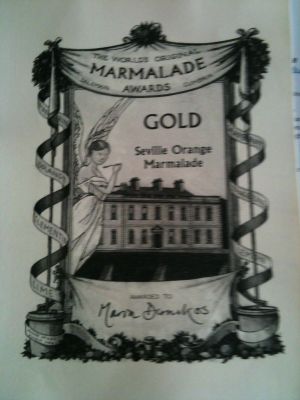
I entered this recipe into the World Marmalade Awards in Cumbria and won a gold award.

Gold

Seville Orange Marmalade

Ingredients

1 lb and one extra orange of Seville oranges

3 lb sugar (I prefer caster)

Juice of 1 lemon

1 sweet orange

3 pints water

Method

Wash all the fruit well.

Using a potato peeler, peel the zest off the Seville oranges and sweet orange. Set these aside.

Cut up the remaining fruit into small pieces and place in a preserving pan with 2 pts of the water and the lemon juice. Cover and leave over night.

With a pair of scissors or a sharp knife cut the peel as you like, either thin or coarse, and place in a second pan and add the remaining 1 pint of water. Cover and leave over night.

The following day put both pans on to simmer for 2 hours. Partially cover the peel pan with a lid to stop the water evaporating too quickly.

If the water level becomes too low in either the fruit pulp pan or the peel pan add some hot water just so as to cover the fruit.

After 2 hours check that both the fruit pulp and peel have cooked through. The orange pulp in the main pan should be very soft – if not simmer for another hour. The best way to test the peel is to taste a small piece. If needed return to the heat for a further hour.

Strain the fruit pulp through a sieve into a clean bowl.

Also strain the peel into the same bowl. Set aside the peel for now as this will be added later.

Measure the total liquid in the bowl from the combined pans – this should be about 1000ml/ 1 ¾ pints. If not add a little water or boil a kettle and pour over the fruit pulp allowing it to drain through a sieve and add this to the marmalade liquor. If there is too much liquid, place back onto the heat and boil down until the correct volume is achieved.

Put the sugar into a roasting tin and place in the oven to warm through.

Pour your 1000ml of marmalade liquor back into the cleaned preserving pan and return to the heat. Slowly add the sugar, stirring it gently, don’t put it in all at once. It is very important to make sure all the sugar dissolves properly. When the sugar has all dissolved add the peel and bring the whole lot to a rolling boil.  Removing the white scum as it forms.

DO NOT WALK AWAY – this amber nectar can turn into the most vile molten lava which will show no mercy on your cooker, unless you like spending an afternoon cleaning – trust me I have been there, never to be repeated.

The marmalade now needs to reach setting point of 105C/220F . There are two methods to test whether it has reached setting point, one is to put a little of the marmalade onto a chilled saucer and put into the fridge and see if it crinkles when pushed back, the other is to use a thermometer. I prefer to use a jam thermometer because it saves all the standing around waiting for the marmalade tester to cool.

Once the marmalade has reached setting point, remove from the heat and leave the marmalade to stand for 10-15 minutes. This should stop the peel floating to the top of the jar when set.

After 10-15 mins pour the marmalade into warmed sterilised jars and seal.

Makes about 6 jars.

Sterlising Jars

To sterilise the jars wash them in hot soapy water and rinse. Place on a baking tray and put into a warm oven Gas mark 3/325F/160C and leave for 10/15 minutes. Carefully take out and use.

I use the rule that it is either wax discs or screw lid not both. The waxed disc will prevent the twist top from creating a proper seal.

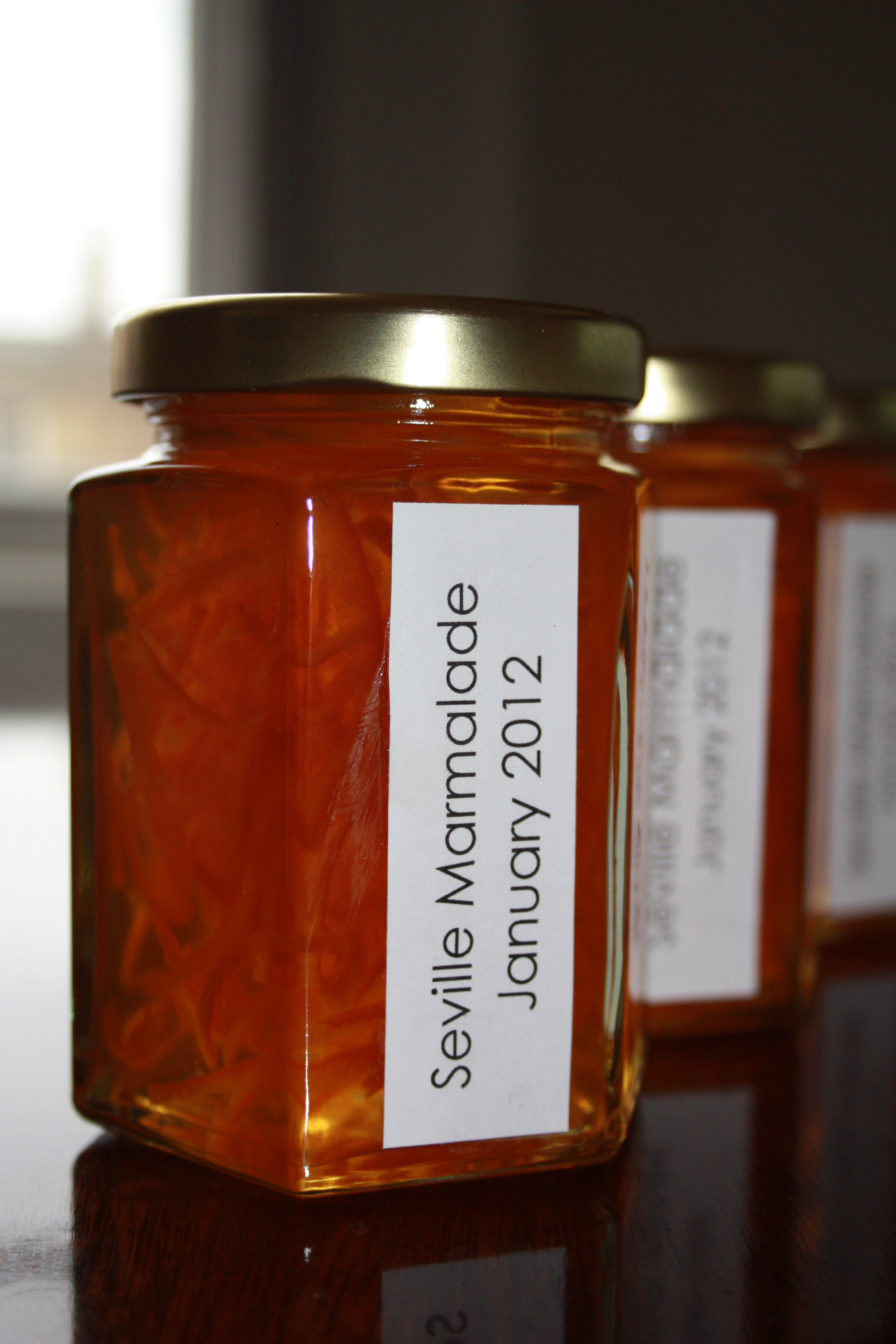
Remember to label and date. I like to keep a jar from the previous year so I can compare tastes.